What is a Data Management Plan?
Table of Contents
- Data Management Plans are a roadmap for research data management.
- Data Management Plans ask you questions to guide best practices for your project
- DMPs are collaborative
- Data Management Plans are “living documents”
- Data Management Plans (DMPs) are also a funding requirement
- Test your knowledge!
- Data Management Plan types and examples
- Examples and Templates
- Test your knowledge!
Timing
It will take you approximately 25 minutes to read and explore this section.

How do you plan your vacation? Do you show up at the airport and hope for the best? Do you buy a ticket at the counter and search for a hotel when you arrive? Most likely you’ve booked your flights, accommodations, and sometimes activities weeks or months in advance. You do research on where you’re going to find things to do, you pack your bag before you go (maybe with a packing list), and you make sure your passport and documents are up to date. When something can easily go severely wrong, advance planning becomes critical. Similarly, developing and regularly updating a data management plan helps make sure you and your team are prepared and that there are no surprises.
Data Management Plans are a roadmap for research data management.
Research data management is the practice of caring for data and research materials throughout the research lifecycle. Good data practices help us as researchers be prepared, avoid losing data to fires, floods or theft, be organized and efficient, and increase access to knowledge. To implement these activities, we start with creating a data management plan!
Learn more about research data and the research lifecycle at Best Practices for Managing Data in your Research.
Data Management Plans ask you questions to guide best practices for your project
A Data Management Plan (DMP) is a document about how you will care for your research data throughout the project. Through a series of five questions, a Data Management Plan will let you think through your research process in advance.
The best time to create a data management plan is at the start of your research project. This can include making sure resources and tools are in place and mitigating problems such as data loss, duplication of effort, or security breaches in advance. However, your research work can benefit from creating a data management plan at any time in the process to help lay out best practices.
DMPs are also an opportunity to engage your research team, partners, and collaborators in an ongoing conversation about how you will be managing research data, which we will discuss in more detail further on.
A Data Management Plan (DMP) describes how you will create, store, organize, document, secure, preserve, and share your research data. In the rest of this module, we’ll go into detail for each of these sections. Pretty much anything that pertains to your research data will go into your data management plan. More specifically:
Responsibility
- How will sensitive data be managed and access restricted?
- Do you have a data-sharing agreement that you have to follow?
- Have you gone through ethics approval?
- Are there any ethical terms you have to follow regarding your data?
- Are there any commercial requirements?
- How are Indigenous Data Sovereignty principles addressed?
- Are there data security risks or dual-use concerns?
Data Collection
- What types of data will you collect?
- What file formats will you gather?
- How will files be version-controlled, organized, and named?
Documentation + Organization
- What documentation will help others understand your data in the future?
- What metadata–data about data–will you collect?
- What data sets are you using, or what new data will be created?
Active Storage + Access
- How are you going to store and backup your data?
- How are you going to keep your data secure?
- If you're working with a research team, how will the team access and contribute data?
Deposit + Preservation
- Where will you deposit your data at the end of your research project?
- How will you ensure data is accessible through preservation-friendly formats?
- What license will you use to tell others how they can use it?
- How will you tell your research community your data exists?
DMPs are collaborative
DMPs support collaboration within your lab or research team. Supervisors and research staff don’t have a lot of time. That means that graduate students and postdoctoral researchers are often the data champions of their research group. Creating a DMP is an opportunity to discuss the roles everyone in the team will have in data management activities to make sure everyone is on the same page about how data will be managed. Having a document everyone can refer to is a great way to implement consistent data practices for a lab or research group. It makes sure everyone knows how data will be stored, and creates a plan with timelines for security practices: backups, transfers, and updates.
What would happen if a collaborator wins the lottery and has to leave the project? A DMP can include an order of responsibility and contingency plans for unexpected events – illness, moving universities, ransomware attack. Remember: everyone in a research group–from students to research staff to Primary Investigators (PIs)–plays an important role in managing research data.
Data Management Plans are “living documents”
Unlike some other things we are asked to do as researchers, a DMP is not a compliance measure; a box that you’ve checked off. It can and should be a useful research tool, regularly updated as a “living document.” A few tips for writing:
- Make sure your practices as written are what you will do
- Consider the scope of your DMP, which can range from a single project grant to a large-scale program protocol
- Be comprehensive, your data may live in many places
- Make it a discussion and involve collaborators, experts, and partners in writing and reviewing the DMP
Don’t just set and forget your DMP. Research is an evolving process, and you can’t know everything at the start of the project. Include reviewing it into the cadence of your current practices. This could be regular research group meetings or meetings with your supervisor. Data Management Plans are “living documents,” reflecting the changes that occur as a project unfolds. They should display the inevitability of change and should be edited and updated on an ongoing basis.
Update your DMP as your project evolves and book a time to review it every year. Has anything changed, now that we’re at this phase of the research? Have we developed any new processes that should be added? Did we end up needing to add another data source, given what we discovered?
Approached this way, a DMP can be an incredibly useful research tool!
Data Management Plans (DMPs) are also a funding requirement
Submitting a Data Management Plan (DMP) is also increasingly a requirement for funding applications, so completing a DMP allows for an an essential skill to develop as research practices evolve.
Why are funders asking for this? Ensuring good data quality leads to research excellence, responsibly and securely managing research data, and avoiding data loss. If governments are investing public funds into research, it makes sense that they would want to make sure the data it creates is kept safe, and possibly shared back if possible.

In Canada, our national research funders are also known as the Tri-Agencies: three agencies to guide disciplinary support for research. Faculty members will be very familiar with these organizations as they apply for grants from them regularly. Graduate students may have a Canada Graduate Scholarship from one of these organizations or know a colleague who has one.
- Canadian Institutes of Health Research (CIHR)
- Natural Sciences and Engineering Research Council of Canada (NSERC)
- Social Sciences and Humanities Research Council (SSHRC)
As the the Tri-Agency Research Data Management Policy continues to take effect, there have been requirements rolling out for increasingly more funding competitions, including:
- CIHR: Selected Network Grants, Team Grants, Operating Grants
- NSERC: Alliance Society, Subatomic Physics
- SSHRC: Partnership Grants
Other Canadian funders also have similar requirements. The Canadian Foundation for Innovation (CFI), which supports infrastructure spending, includes a Sustainability section which invites researchers to plan for how data will be managed into the future. McMaster researchers have also created plans for the Ontario Research Fund and other Canadian grants.
Canadian funders are also asking for DMPs in alignment with their international counterparts. In the US, the National Science Foundation (NSF) and the National Institutes of Health (NIH) both require DMPs (or a variant) to be submitted with the grant application. The Wellcome Trust in the UK also requires a DMP, as do a lot of the other European funders such as Horizon Europe (which some McMaster researchers participate in).
Writing a Data Management Plan early in a research project provides a practical way to prepare for future grant applications.
Test your knowledge!
Data Management Plan types and examples
Data Management Plans evolved as a practice in early aeronautics and engineering research in the 1960s. If you’re curious, there are some very neat vintage NASA Data Management Plans and Project Data Management Plans from the 90s.
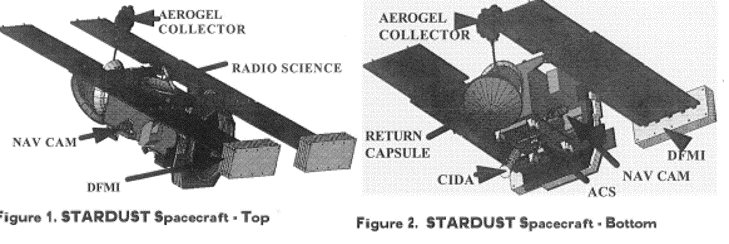 Image: NASA Data Management Plans and Project Data Management Plans
As data management plans evolved into other fields and disciplines, they began to take on a very flexible format. These might have different purposes at different points in the research process. They can also grow and adjust as your project does!
Project DMP
Most researchers complete a simple 5-question Project DMP.
- Usually quite short, around 2-3 pages
- Created for specific projects
- May be written for a funding application.
For this module’s exercise, we will be creating a Project DMP
Tip
We have the Digital Research Alliance of Canada (DRAC) provides infrastructure and guidance for research data management, including the DMP Tool we will be using and example DMPs. Their example plans are carefully reviewed and workshopped to showcase best practices. Take a look at this Mixed Methods Research Example or this one on Computational Reproducibility. If this doesn’t align with your research, we’ll share some other DMP Examples soon.
Research Group DMP
However, research groups and large projects might need a more involved DMP to guide their work. Some funding applications are looking for a DMP that is more like a data governance framework or a larger programme of study, for example CFI or SSHRC Partnerships grants. These will include considerations on how users of a facility should manage data, how the facility manages user data, retention periods, and exit strategies. If this is the case, you can start with the 5-question DMP we’re about to create and expand it by adding governance processes and protocols. Don’t hesitate to reach out to rdm@mcmaster.ca to discuss options.
- You can use your Research Group DMP as a starting place to guide data practices for a Project DMP.
- These are very long, sometimes 20-50 pages
- They outline the research group practices in detail to get researchers, collaborators, and participants on the same page about how data is managed.
- Often includes detailed protocols, SOPs, and are great tools for onboarding new team members.
Note: a Project DMP can grow into a Research Group DMP as you start to add pieces and details. DMPs are scalable resources.
Tip
An excellent example of a Research Group DMP is one from McMaster’s Promoting Healthy Families project. While it may be more comprehensive than a smaller project requires, it shows how a DMP functions within our IT and ethics environment. Promoting Healthy Families Data Management Plan.
Examples and Templates
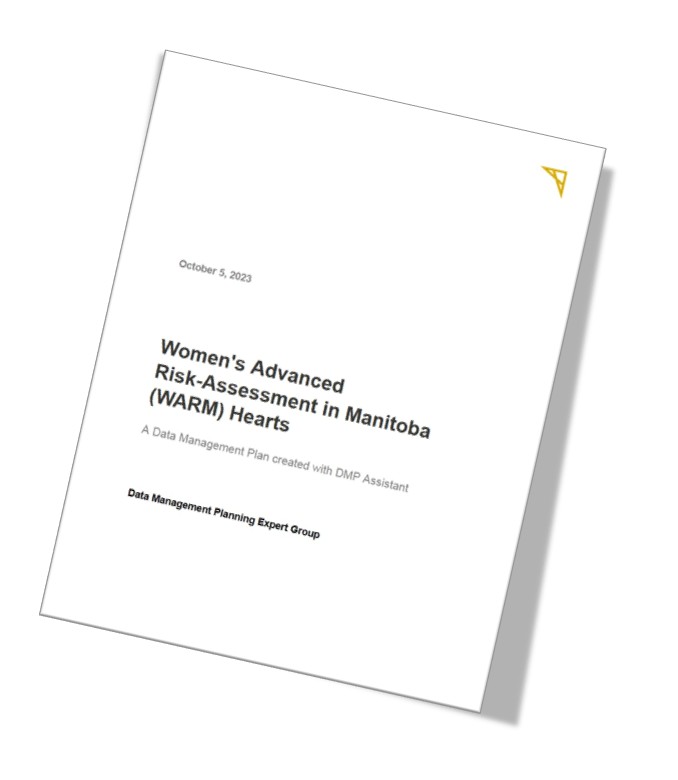 As we go into the writing portion of this module, it will be helpful for you to find a DMP Example. Examples show you how other researchers in your field approach data management. This is helpful for all researchers, but especially early career researchers!
Here are a few of our favourites for each faculty:
- Business:
- Engineering:
- Health Sciences
- Humanities
- Science
- Social Sciences
There may be an even more perfect match for your research! Visit our DMP Database and search by keyword or sort by your department filter on the right side.
For this module, we’re going to use the DMP for “People, Places, Policies and Prospects: Affordable Rental Housing for Those in Greatest Need” to as an example for how a researcher has approached writing each section. However, we recommend finding a DMP that’s closer to your research to follow along as well.
Leviten-Reid, C. (2020). Data Management Plan for People, Places, Policies and Prospects: Affordable Rental Housing for Those in Greatest Need (Exemplar). Zenodo. https://doi.org/10.5281/zenodo.4062466
Example sections will appear like this:
How and where will your data be stored and backed up during your research project?
Storage space is anticipated to be approximately 100GB. The data will be stored for 5 years locally, with a permanent copy held in the Scholars Portal Cape Breton University Dataverse. The 3-2-1 backup rule will be followed for data storage and backup. This means that team members will create three copies of all data files, to be stored on two different types of media, with one copy kept in an off-site location. Examples of different media types include those which are removable (USB2), fixed (such as a hard drive on a laptop) and networked (such as cloud-based servers).