
1. Responsibility
Table of Contents
Timing
It will take approximately 20 minutes to read and explore this section. The time required to answer the data management plan question will vary.
This section will really vary depending on the nature of your research.
If you are working with research participants, there will almost always be considerations for protecting their data as part of your research ethics process.
If you’re working with Indigenous data and including information about land-based knowledge and research by and with Indigenous communities, there are government-to-government, treaty, and Indigenous Data Sovereignty considerations to navigate. As we mentioned in our land acknowledgement, the Tri-Agencies require researchers to involve Indigenous nations, communities, and individuals in creating a Data Management Plan for projects that involve them.
If you are working with secondary data from a government, another researcher, data repository, industry partner, or other entity, you may have data access rules you need to follow.
In cases where you have industry partnerships, there could also be commercialization and intellectual property considerations.
In some fields, data sensitivity is required for ecological protections or from legal and safety mandates around dual-use, military, or sensitive technology research.
But if you’re working with open data on fruit flies, this section might not be very long!
Write Plan: Responsibility
Preview and answer the question on DMP Assistant after reading through the section.
Write Plan: Responsibility
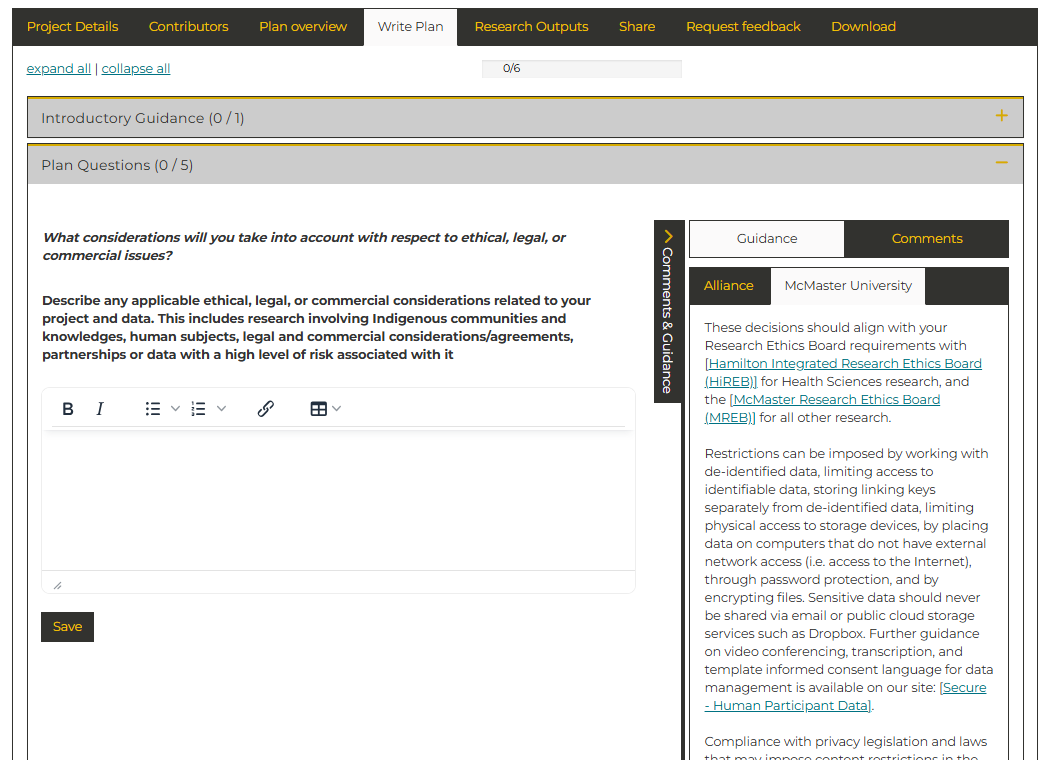
First, we will answer the question “What considerations will you take into account with respect to ethical, legal, or commercial issues?”
Go to DMP Assistant and navigate to the “Write Plan” tab. Open “Plan Questions” and begin filling out first answer to the question.
Make sure you click over to the McMaster University Guidance Sidebar for a reminder of the different considerations in this section.
1. What considerations will you take into account with respect to ethical, legal, or commercial issues?
The given questions will advice you on how to approach specific responsibilities.
- Describe any applicable ethical, legal, or commercial considerations related to your project and data.
- Does your research involve Indigenous communities and knowledges, human subjects, legal and commercial considerations/agreements, partnerships or data with a high level of risk associated with it?
- Potential documents to reference include the ethics application, data sharing agreement, community agreement, consent forms, and research protocol documents.
Sometimes researchers use a DMP as a “scratch pad” to write out what they think the plan can be before they go through an ethics application or security review process. This lets you write something down to run by your industry partners, research participant collaborators, research team, or supervisor.
Reminder! Click “Save” once you have answered this question.
Resources: Indigenous Data Sovereignty

Researchers engaging with Indigenous data have responsibilities for data management practices that support Indigenous data sovereignty.
Principles should be guided by Indigenous nations and can include:
- First Nations Information Governance Centre’s OCAP® principles which support First Nations in working with researchers
- National Métis Health Data Strategy and Principles which represent a cycle of reciprocal relationships within safe and inclusive environments, driven by stewardship and underpinned by respect, research ethics, Metis Context, and recognizing diversity.
- ᐃᓄᐃᑦ ᑕᐱᕇᑦ ᑲᓇᑕᒥ (Inuit Tapiriit Kanatami) has a National Inuit Strategy on Research which ensures Inuit access, ownership, and control over data and information.
- The McMaster Indigenous Research Institute (MIRI) has an Indigenous Research Primer which guides those who are engaging with Indigenous Peoples and their work.
Each Indigenous community is different. Researchers should work with communities and recognize they may have their own principles of research and research data management. Not all First Nations will want to use OCAP®, for example!
This is echoed in the Tri-Agency Research Data Management Policy, “For research conducted by and with First Nations, Métis and Inuit communities, collectives and organizations, DMPs must be co-developed with these communities, collectives and organizations, in accordance with RDM principles or DMP formats that they accept. DMPs in the context of research by and with First Nations, Métis and Inuit communities, collectives and organizations should recognize Indigenous data sovereignty and include options for renegotiation of the DMP.”
When completing your DMP, make a note of how you will uphold your responsibilities for data sovereignty, in detail. For example, not “I will comply with OCAP®” but “Six Nations will retain ownership of the data on this server.”
Resources: Ethical, Legal, and Commercial Considerations
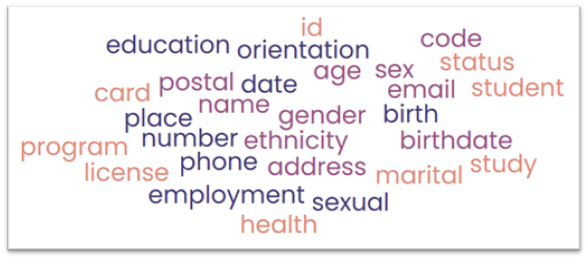
Sensitive data is any data that could cause harm if released openly. This includes personally identifiable information or personal health information. It can also include confidential business information (such as data that might lead to a patent) and sensitive ecological information (like nesting sites for endangered species).
Restrictions can be imposed by working with de-identified data, limiting access to identifiable data, storing linking keys separately from de-identified data, limiting physical access to storage devices, by placing data on computers that do not have external network access (i.e. access to the Internet), through password protection, and by encrypting files. Sensitive data should never be shared via email or public cloud storage services such as Dropbox.
Ethics
What is the least amount of personal information you need to collect to answer your research question? What is the harm that could come to someone from their data being released?
Don’t collect identifiers that aren’t relevant to the research but don’t avoid collecting important information. Do you need someone’s exact birthday? Do you even need someone’s exact year of birth?
- You will likely encounter this in your research work, but check out the Tri-Council Policy Statement: Ethical Conduct for Research Involving Humans web course: TCPS2: CORE-2022 Course on Research Ethics
- The relevant ethics board for your study depends on your faculty and project procedures. To choose the correct ethics board, read the criteria in the guide HiREB or MREB?
- The McMaster Research Ethics Board (MREB) can be accessed here. The Data Storage and Security Tools may also be helpful.
- The Hamilton Integrated Research Ethics Board (HiREB) can be accessed here.
For more tools and direction:
- AskResearch has a new guidance document on approved tools for transcribing research audio. There are also guidance documents on survey software and video conferencing for research.
- Key Considerations for Data Privacy, Security, & Compliance
- Electronically Documenting Consent
- AI Guidelines for Researchers
Secondary Use of Data and Industry Collaborations
You may be working with confidential business information (such as data that might lead to a patent). If this is the case for you, the data provider might request for specific requirements and measures before transferring data or equipment to you. You need to align with these responsibilities as a researcher. Or, you might be receiving secondary data from a government body, a schoolboard, or another researcher.
The data or material provider may also have specific requirements for you around how and when they can access the data, and how it is shared at the end of the research project.
- For non-disclosure, intellectual property, and licensing agreements: Faculty Research Contracts Advisor in the McMaster Industry Liaison Office (MILO)
- Health Sciences researchers: contact your Agreements Officer to draft an agreement. Health Research Services (HRS) will assist you with negotiating with other parties to the agreement and gathering McMaster institutional signatures.
- Researchers in other faculties: Development Unit contact in the Research Office for Administration, Development and Support (ROADS)
Dual use data
“Dual use” technologies and data are data that could have a military application. Even if you don’t think your research is sensitive or relevant to military applications, research that involves public health, biomedical engineering, space and satellite technology, personal data, nuclear fusion, certain technologies, and digital infrastructure, may have an unintended use to a national threat actor. For example, research on whale communication may have secondary use as sonar records with intelligence application. Given the current geopolitical climate, caution is needed.
McMaster has a Research Security Office which can help with Safeguarding Your Research.
Sensitive species data
Did you know sometimes sensitive species can be at risk by research too? This article in Mongabay, “Reptile traffickers trawl scientific literature, target newly described species,” describes how traders use research outputs to track and sell animals.
If this could be your data, check out the Current Best Practices for Generalizing Sensitive Species Occurrence Data
Learn More:
For more details about working with and managing sensitive data, check out our workshop “Securely Managing and Publishing Sensitive Data”.
DMP Example: Responsibility
Here’s how this section looks like in the DMP for “People, Places, Policies and Prospects”.
Responsibility
No sensitive data will be shared. Any sensitive data will be stored on secure servers for 5 years.
Research has been approved by the Research Ethics committees at the various institutions involved in the project. Participants are also required to sign the informed consent agreement. By mediating data requests and determining their own terms of access, researchers maintain their rights to the intellectual property.
Responsibility Checklist
Once you have completed the responsibility section, use the rubric below to evaluate and strengthen your response. This rubric is based on the Alliance Simplified Template (Funding Application Stage) Rubric.