
2. Data Collection
Table of Contents
Timing
It will take approximately 15 minutes to read and explore this section. The time required to answer the data management plan question will vary.
If your research involves biological samples or survey results, you may feel fairly confident you’re working with research data. But what if your research is rooted in creative practice? What if you’re looking for the specific heat of a material under a magnetic field? What if you work with archives or texts by other scholars? What if you’re working on an industry-sponsored initiative?
Data take many different formats, from the classic spreadsheets produced by instrumentation and statistics downloaded from a government to survey responses, battery decay rates, archival images, data provided by an industry collaborator, and more. If you can use it as a building block to come up with new knowledge or understanding, it could qualify as research data. Research data inform findings or contributions that are then shared through research outputs: publications, knowledge translations, projects, and more.
The following diagram shows a variety of research data, click the plus signs on the graphic below to learn more!
Other notable examples of research data may include data files, questionnaires, transcripts, samples, physical collections, software, models, algorithms, lab notebook, codebooks, methodologies, workflows, and other materials to be produced during the course of the project.
Write Plan: Data Collection
Write Plan: Data Collection
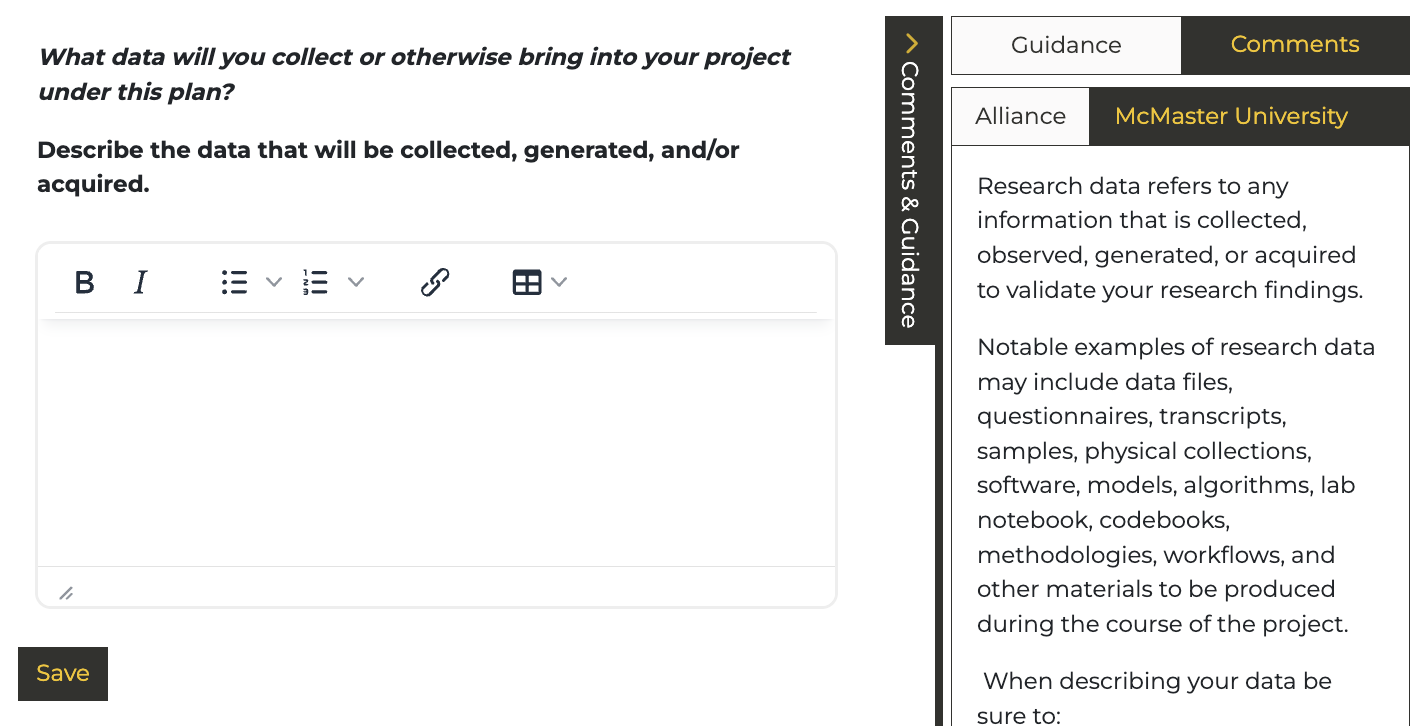
For this section, we will respond to the question “What data will you collect or otherwise bring into your project under this plan?”
Go to DMP Assistant and navigate to the “Write Plan” tab. Open “Plan Questions” and begin filling out the second answer to the question.
Make sure you click over to the McMaster University Guidance Sidebar for a reminder of the different considerations in this section.
2. What data will you collect or otherwise bring into your project under this plan?
You will respond to the following question prompts to describe the data that will be collected, generated, and/or acquired.
- What types of data do you have? (e.g., image data, textual data, numerical data, audiovisual, etc)
- What format is your data in?
- How much data do you have?
- How will the data be collected or generated? - if existing data will be used, what is the source of the data and what data will be used?
- Indicate if your data is, or may be, considered sensitive (e.g., health, administrative and/or clinical records, participant interviews).
- Indicate if your data involves Indigenous communities and/or knowledges and information.
This section addresses data collection issues such as data types, file formats, naming conventions, and data organization–factors that will improve the usability of your data and contribute to the success of your project.
Important: Click “Save” once you have answered this question.
Resources: Data Collection
What file formats will your data be collected in? Will these formats allow for data re-use, sharing and long-term access to the data?
If you are working with proprietary file formats and software, try to save a version in an open, standard format when possible, such as CSV, TXT, JSON, and XML files. This supports long term data retention and archival. If you are sharing data, it ensures that collaborators or data users are able to access and use your data without special software.
You may find a table to be helpful in organizing this section. Here’s an example of what this can look like:
| Data Type | Data Sources | File Formats | Relevant Software |
|---|---|---|---|
| Qualitative data | Interviews | .wav (pre-transcribed), .docx (post-transcribed) OneNote (interview notes) | Zoom (conducting interviews and transcription), Taguette (analyzing data) |
| Spreadsheet | Secondary data from Statistics Canada | .xlsx (active research), .csv (active research, archiving) | Excel (data cleaning), R (data analysis) |
| Accelerometry Data | Accelerometer Sensor | .csv with X, Y, Z axes | Excel, MATLAB |
Learn More:
For more information and further resources, refer to the McMaster RDM webpage on Sustainable File Formats.
Resources: Secondary Data
While many researchers collect data, you may also be using secondary data from another source. Someone else may have already collected the data you’re looking to work with. You can also use data for testing and parameterization, or to confirm your results against another researcher’s. If you are using secondary data, you should clearly identify:
- The source of the data,
- What the conditions were to access the data, and
- What format the data is in (.csv, .dta, etc).
Where to find Data
Lunaris is a national discovery service for multidisciplinary research data from institutions across Canada, including McMaster Dataverse.
OpenAIRE Explore is a European AI driven open search engine, containing millions of research data, software, and publications.
Google Dataset Search (Global) is search engine from Google to help researchers find openly available data.
Statistics Canada Microdata provides a large collection of social surveys, you can access it through McMaster’s Statistics Canada Research Data Center.
McMaster Libraries Data Services can help you find appropriate data from worldwide collections.
DMP Example: Data Collection
Here’s how this section looks like in the DMP for “People, Places, Policies and Prospects”.
Data Collection
Data collected during our projects may include, but are not limited to, those gathered from surveys, in-depth interviews, focus groups, community conversations and arts-based methods such as photography. This means we will potentially generate numeric, audio, image, video and text-based data.
This research project is collecting a variety of types of data. Examples of these include XML and CSV for databases and spreadsheets, JPG or TIFF files for images, MP3 files for sound and TXT for text. Each of these file types are non-proprietary, ensuring ease and flexibility of reuse.
Data Collection Checklist
After answering the data collection section, use the rubric below to evaluate and strengthen your response.