5. Long-Term Data Management - Ensure data are preserved, discoverable, and accessible
Table of Contents
Timing
It will take approximately 20 minutes to read and explore this section. The time required to answer the data management plan question will vary.

While open science is incredibly important, it is also important to consider responsible long-term data stewardship. Think about what happens to your data after the project ends, what will be retained and where will it reside? Different datasets have different futures. After a project, your data may be retained, archived, deposited, or destroyed.
Not everything needs to be preserved forever. A useful way to think about long-term data management is like cleaning out your room after moving out. More likely than not, you aren’t going to keep every single object. You might keep photos and treasured items. But you might not keep old CDs or dusty magazines. The same applies to research data.
When thinking about what to retain, bear in mind the following:
- Clean up your files – filenames, folders, file types!
- Save your data in multiple safe places – but choose what is worth saving
- Keep documents that describe your data – store data with enough information that you will still understand it in 2 years!
When thinking about what to share, consider:
- Risk level of data
- Right to share data
- Moral and ethical reasons
Remember to adhere to funding agency requirements, journal data policy requirements, and ethics board review. Not all data that are kept need to be shared publicly.
- Learn more at Data Retention in RDM
Write Plan: Long-Term Data Management
Write Plan: Long-Term Data Management
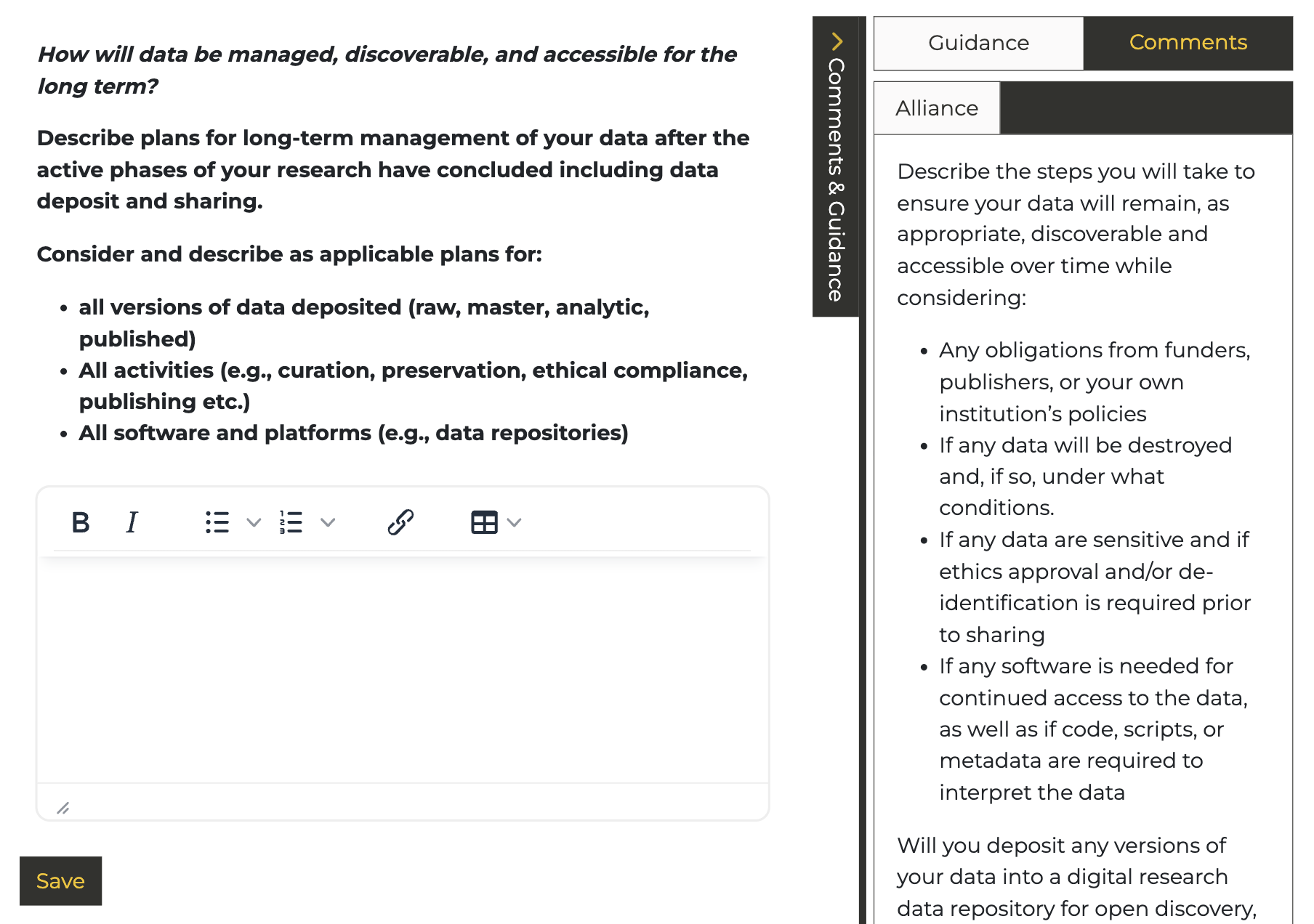
Go to DMP Assistant and navigate to the “Write Plan” tab. Open “Plan Questions” and answer “How will data be managed, discoverable, and accessible for the long term?”
Make sure you click over to the McMaster University Guidance Sidebar for a reminder of the different considerations in this section.
In this section, you will think about where data will live once the project is complete.
5. How will data be managed, discoverable, and accessible for the long term?
- Describe plans for long-term management of your data after the active phases of your research have concluded, including data deposit and sharing. Consider and describe as applicable plans for:
- All versions of data deposited (raw, master, analytic, published)
- All activities (e.g., curation, preservation, ethical compliance, publishing etc.)
- All software and platforms (e.g., data repositories)
- Will you deposit any versions for discovery, appropriate access, and potential reuse?
- Are there any responsibilities to funders, publishers, ethics boards, research participants that impact this?
Reminder! Click “Save” once you have answered this question.
Resource: Research data repositories
Publishing data in a reputable data repository is the best way to share and archive data.
- To share data, deposit it unto a data repository, a platform designed for the long-term preservation, management, and discovery of research data.
- If you are affiliated with McMaster, you can share data on McMaster Dataverse, an open-source institutional data repository within Borealis, the Canadian Dataverse Repository.
Domain Specific
Repositories
Focus on specific types of data, such as brain imaging or astronomical information. See an extensive list of domain specific repositories here.
Repository Finder
This tool by DataCite can help you find an appropriate repository: Repository Finder
Interactive Activity
Case Study Analysis: Determine what repositories are best suited for each scenario.
Scenario 1:
A neuroscience research team has collected MRI brain imaging data and accompanying participant metadata. The project collaborators want the dataset to be reusable by other neuroscience researchers and compatible with field-specific standards.
Scenario 2:
A climate science lab wants to share its cleaned dataset and the R scripts used to analyze and visualize the results. The team expects other researchers to adapt the scripts over time and contribute improvements.
Scenario 3:
A graduate student completed a research project which includes spreadsheets, interview summaries, consent documentation, and a final dataset. The student cannot identify a well-established repository commonly used in their discipline but still wants the data preserved and citable.
Data De-Identification & Anonymization:
If your research involves human participants, consider whether personal information should be removed before preserving or sharing your data. Before getting ahead, you must get participants’ permission to share datasets to complete de-identification and anonymization. De-identification removes or changes direct identifiers such as names, student numbers, or addresses. While anonymization takes it to another level and ensures that the dataset is impossible to de-identify and cannot be linked to related information.
Recommended tools and training:
- Portage Network De-Identification Guidance https://zenodo.org/record/4270551
- RDM – Publish – Data Anonymization: https://rdm.mcmaster.ca/publish#tab-data-anonymization
Data Licenses
A data license communicates how others may use your data once they have access to it. The most common licenses are:
Data Availability Statements
Data availability statements (DAS) are guides that share information about data access and availability. It is typically used to inform in detail how and where people can access data depending on the restrictions.
Visit this guide on: How to write a data availability statement: A brief guide
Here is an example of a data availability statement from the Canadian Longitudinal Study on Aging (CLSA).
Canadian Longitudinal Study on Aging (CLSA), Publication and Promotion Policy for CLSA Approved Users, November 29, 2022, Accessed April 17, 2024, https://www.clsa-elcv.ca/doc/2579
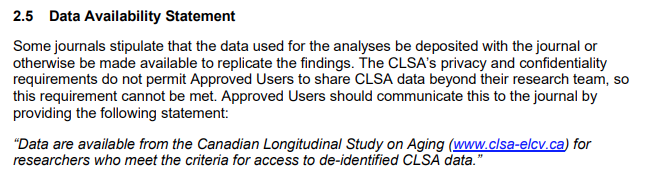
Zhang W, Sun H (2020) Formal and informal care received by middle-aged and older adults with chronic conditions in Canada: CLSA data. PLoS ONE 15(7): e0235774. https://doi.org/10.1371/journal.pone.0235774
DMP Example: Long-Term Data Management
Here’s how this section looks like in the DMP for “People, Places, Policies and Prospects”.
Long-Term Data Management
The analyzed, de-identified data set or datasets will be put under mediated access in the Scholars Portal Cape Breton University Dataverse. Users will be required to request access to the data for reuse.
Requests will be evaluated by the PI and/or a backup member identified on the research team. Terms of access and use will be determined by the PI in consultation with the research team to ensure appropriate use of the data.
Data deposited in Dataverse will be assigned a Digital Object Identifier (DOI), a unique and persistent code that can be used by others to locate and access these data. Metadata is harvested by the FRDR, a Canada wide research repository, where data can be discovered, and then shared, at a national level. We will also link our dataset to the publications arising from this study.
Long-Term Data Management Checklist
After you have completed this section, use the rubric below to evaluate and strengthen your response.