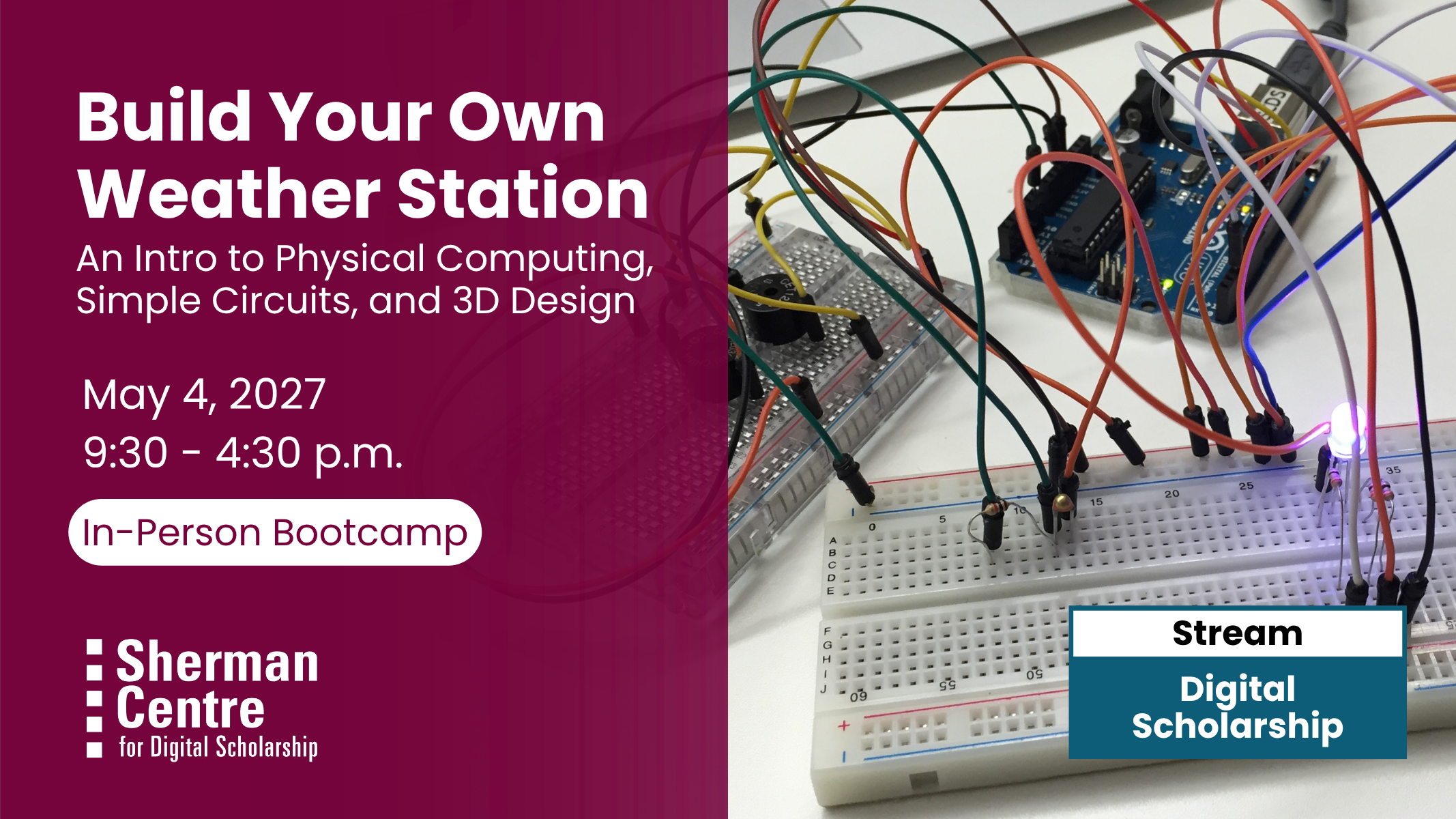
Build Your Own Weather Station: An intro to physical computing, simple circuits, and 3D design
Everyone talks about the weather, but have you ever thought about measuring it? From community crowdsourcing applications to projects around the house to more rigorous research applications, low-cost weather stations can be valuable monitoring tools and a source of personal learning and enjoyment. In this full-day, hands-on and in-person bootcamp, you will learn how to build and program simple circuits that connect a microcontroller (Arduino) to a suite of environmental sensors (temperature, humidity, light intensity, etc.) to make a working weather station. In the second half of this session, you’ll learn the basics of 3D model design and development to create a 3D-printable model of an enclosure for your station.
No prior experience with electronics or 3D model development is required, as we’ll start at the basics!
By the end of this session, you should be able to:
- Describe the fundamental concepts and operational principles of simple circuits, sensors and actuators.
- Apply fundamental principles to build simple circuits that interact with their surrounding environments.
- Create and modify software code to control the device and create comments to document its functionality.
- Explain the basics of temperature measurement and the considerations necessary to do it with accuracy and consistency.
- Discuss the basic principles of 3D model design and development.
- Use 3D modeling software to create and modify simple print-ready models.
- Apply basic knowledge of weather station design to build a working prototype of the digital system and physical enclosure.
Workshop Preparation
(Jay will update the preparation part himself a little later in the year)
Facilitator Bio
Jay Brodeur (he/him) is the Director of Digital Scholarship Infrastructure & Services and the Administrative Director of the Sherman Centre for Digital Scholarship. Jay has years of experience working with data in a wide variety of formats and interdisciplinary contexts. A scientist by training with a PhD in Earth and Environmental Sciences, he’s comfortable working and advising on all kinds of data-related activities, ranging from data wrangling and integration to analysis and mapping to research data management. Jay’s also keenly interested in the application of digital approaches to support experiential learning opportunities within and outside of the classroom.
John Fink is the Digital Scholarship Librarian in the Sherman Centre.
Workshop Slides
Coming soon.