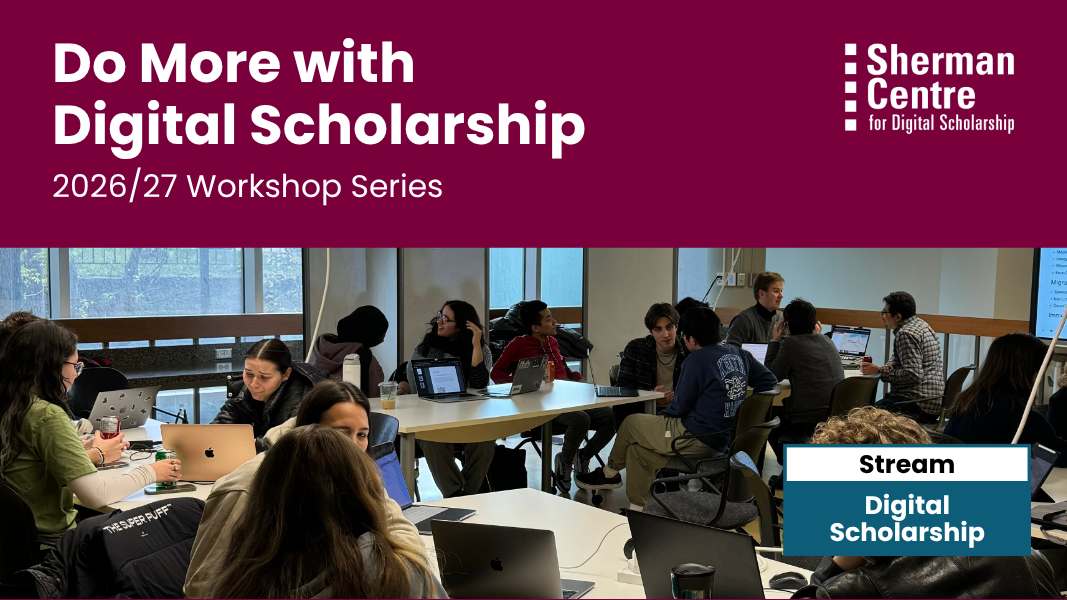
Welcome to the 2026-27 Do More with Digital Scholarship Webinars
What is digital scholarship, how can I do more with it, and how can it contribute to my research and teaching? Join us for our free workshop series that introduces McMaster students, faculty, and staff to the multifaceted domain of digital scholarship.
Join us to:
- Develop skills for professionalization.
- Learn to use software to create digital exhibits, perform data analysis and create dashboards, and organize your research images.
- Engage with faculty, staff, and students on a wide range of topics.
- Learn more about digital approaches to research and knowledge mobilization.
- Explore the intersections between digital scholarship and critical humanities; cybersecurity and data justice.
Workshop Eligibility
All workshops in this series are eligible for the Sherman Centre’s certificate program. For more information, visit scds.ca/certificate-program. They are also eligible for the Canadian Certificate for Digital Humanities. To learn more, visit ccdhhn.ca.
2026-27 DMDS Workshops
- An Agentic Scholarly Workflow
- Build Your Own Weather Station: An intro to physical computing, simple circuits, and 3D design
- Creating Documents with LaTeX
- Creating Interactive Data Visualizations with Power BI
- Creating Small and Ugly Open Educational Resource (OER)
- Data Feminism: power, inequality, and social change
- Field Recording: Capturing audio for podcasting, qualitative research, environmental science, art, music, and more!
- Getting more out of LaTeX: Citations, presentations, and dissertations
- Introduction to SQL
- Local Applications in Generative AI on your Laptop
- Qualitative Data Bootcamp: clean collection, de-identification, and analysis basics
- Responsible AI in Digital Humanities Projects
- Simple Sabotage: A Field Manual for Refusing Corporate AI
- Social media scraping and analysis with Zeeschuimer and 4Cat
- Tools for Digital Storytelling
- Topics, methods, and resources to “do more with Digital Scholarship”.
Land Acknowledgement
McMaster University is situated in Ohròn:wakon which is the traditional territories of the Erie, Neutral, Huron-Wendat, Haudenosaunee and Mississaugas. This land is covered by the “Dish With One Spoon Wampum Belt Covenant”, an agreement between the Haudenosaunee confederacy and Anishinaabe nations to ensure those who live here take only what they need, leave enough in the dish for others, and keep the dish clean. This land is also covered by the Between the Lakes Treaty of 1792 and is very close to the 1784 Haldimand Treaty, which holds the land six miles to each side of the Grand River as a tract for Six Nations, which is currently not being honored.
Many of us at the Sherman Centre took the First Nations’ Information Governance Centre’s OCAP course this past year which stands for Ownership, Control, Access, and Possession. We encourage you to learn more about OCAP and Indigenous data management practices more broadly, including the OCAS principles endorsed by the Manitoba Métis Federation, the principles of Inuit Qaujimajatuqangit, ᐃᓄᐃᑦ ᑕᐱᕇᑦ ᑲᓇᑕᒥ (Inuit Tapiriit Kanatami) National Inuit Strategy on Research, and Global Indigenous Data Alliance’s CARE principles.